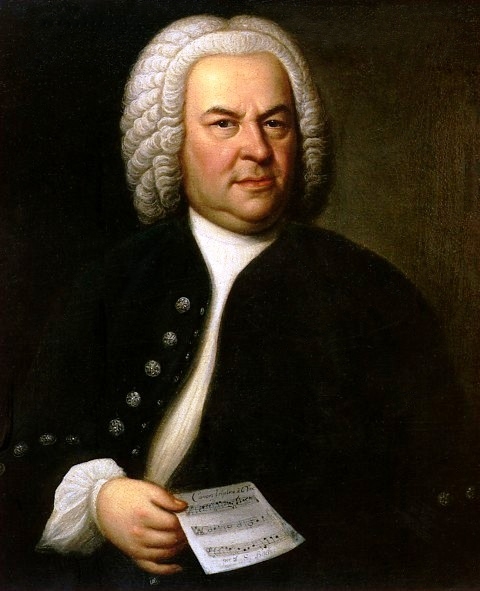
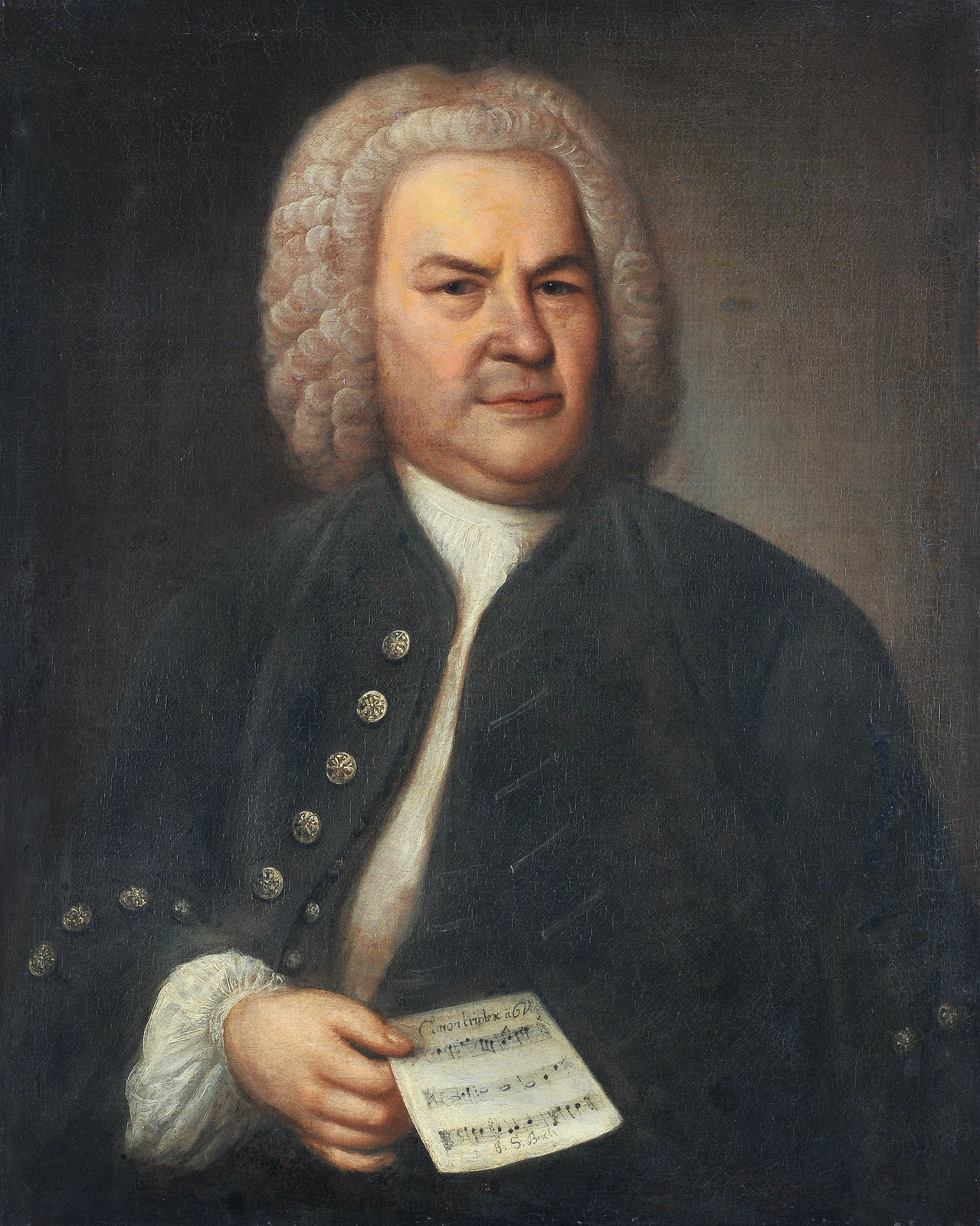
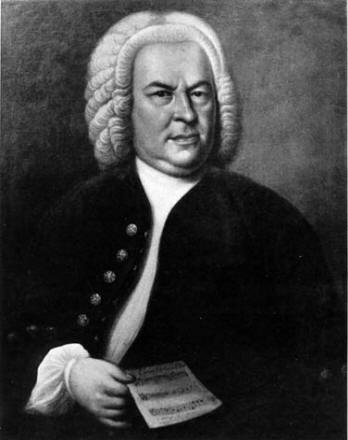
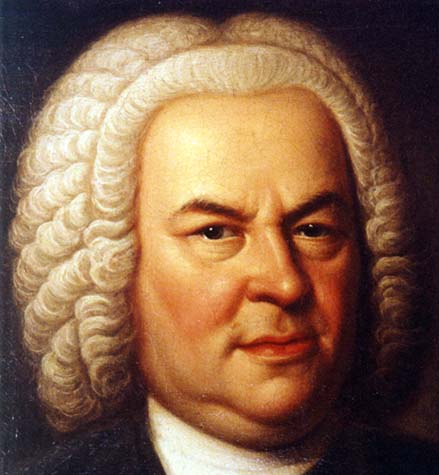
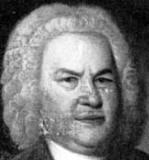
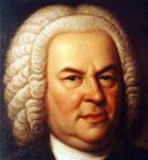
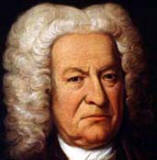
The second Haussmann portrait, dated 1748, belonged to Carl
Philipp Emanuel Bach: Burney saw it in Hamburg in 1772, and it is listed
in the estate inventory of 1790. After its sale in 1796 or 1797 it
disappeared from view. In the course of the nineteenth century it came
into the possession of the Jenke family, from whom William H. Scheide
(Princeton, New Jersey) acquired it in the early 1950s. Scheide died in
November 2014 and bequeathed the portrait to the Bach-Archiv Leipzig.
Unveiled in the Nikolaikirche on 12 June 2015, it has since hung in the
treasure room of the Bach-Museum, a few hundred metres from the 1746
portrait in the Altes Rathaus.
The painting is in a far better state than the 1746 version, which lost
much to cleaning and repainting. But it is not untouched: the sheet of
music with the Canon triplex à 6 has
been retouched, to add the symbols needed for performing the canon
(Gardiner 2013). On that point the 1746 portrait is the more reliable
witness.
What follows is Teri Noel Towe's text of 2001, written when
the portrait was still in Princeton. His opening paragraphs, overtaken
by the events described above, are omitted.
There is no denying that the picture's remarkable state of preservation
is an important factor in the impact that it has on the viewer. In my
own case, I can honestly say that that impact is undimmed after 34 years
of "friendship." And, precisely because it is so well preserved, it is,
as far as I am concerned, the principal and primary image to use for
comparative purposes. While C. P. E. Bach had long been known to have
owned an original Haussmann portrait of his father, its whereabouts
remained unknown for over 150 years. That the painting had even survived
was not known until 1950, when Hans Raupach announced its existence in
his little monograph Das wahre Bildnis Johann Sebastian Bachs.
The black and white photograph is the frontispiece of Raupach's book.
The 1748 Haussmann is not exempt from controversy, however, nor has it
been immune to attack. Besseler, for example, dismisses it completely,
preferring to rely instead on the 1791 ]. N. David copy of the
1746 Haussmann Portrait, a curious position, to say the least.
Part of the problem comes from what is evidently the only significant
restoration to which the 1748 Haussmann portrait has been subjected. The
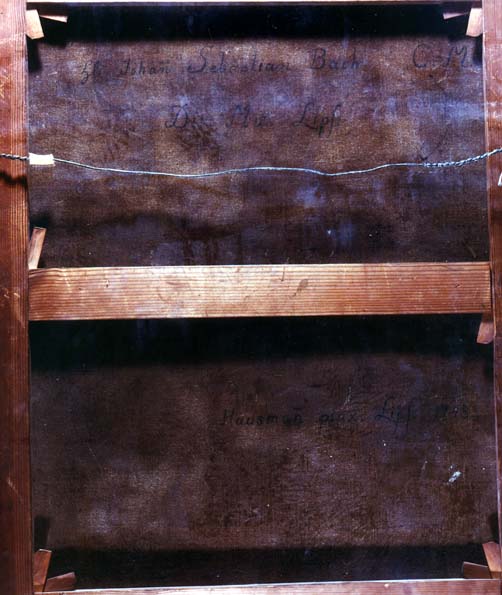
canvass has been relined, and when it was relined, probably early in the
20th century, the inscription on the back of the original canvass was
"transferred" (i.e., copied) on to the back of the relined painting.
The problems with the transferred inscription, apparently, are
two-fold.
First of all, the text of the inscription "deviates from Haussmann's
usual type of signature." (Neumann, BDL, p. 402)
Secondly, and perhaps more importantly, the accuracy of the
transcription of the date -- 1748, rather than 1746 -- has been a
source of controversy.
There are several reasons for this. First, the "8" could be a misread
"6". If that were to prove to be the case, a disconcerting anomaly would
be explained away. The apparent two year discrepancy has gnawed at
scholars, who consistently seem to assume that the replica had to have
been a part of a "two for one" package deal that Bach negotiated with
Haussmann. Such a "discount package" concept is appealing, but it is
based on the assumption that the inscription originated with Haussmann,
an assumption that I now reject as both unwarranted and incorrect.
I now firmly believe not only that the inscription did not originate
with Haussmann, but also that it was added after the deaths of both
Johann Sebastian and Carl Philipp Emanuel Bach. But a detailed
discussion of why I have come to that conclusion will have to wait for
another day, in part because I haven't done all of my homework on this
question yet and in part because it is clearly way beyond the scope of
this presentation. The provenance of the 1748 Haussmann is not certain,
by any means, but the description that Burney provides in his 1772
account of his visit with C. P. E. Bach in Hamburg makes it clear that
C. P. E. had the painting in his possession by that time. The next gap
comes after his death. That the painting remained in the possession of
his widow and spinster daughter is proven by its inclusion in the
official estate inventory of 1790. Who bought it when it was eventually
sold in 1796 or 1797, is not known, but, according to the Jenke family,
from whom Bill Scheide obtained the painting in the early 1950s, the
painting had been acquired "from a Berlin antique dealer sometime after
1800" (Neumann, BDL, p. 402). Certain tantalizing clues on the back of
the frame and on the stretcher suggest, however, that the painting
changed hands more than once between its sale by the heirs of Carl
Philipp Emanuel Bach and its acquisition by the Jenke family, whenever
that took place during the 19th century.
[Omitted here: Mr. Towe's account of an
examination under ultra-violet light in November 2000, and the
conjecture he attaches to it: that the 1748 portrait was painted from
life. That is a hypothesis without supporting evidence, as he himself
concedes, and it runs against the standard view, which takes the
painting to be Haussmann's own replica of his 1746 portrait (Neumann,
BDL). His full text is at bach-cantatas.com.
DW]
No description of this icon of musical portraiture could possibly be
more accurate or more eloquently expressed than Christoph Wolff's
explanation of the raison d'etre for the Haussmann portraits
in his new monograph, Johann Sebastian Bach, The Learned Musician;
with one significant exception that will become obvious in a few
minutes, it cannot be bettered, and I hope that Christoph, who is a
valued colleague and friend, will forgive me for quoting it in
extenso:
"When portrait painter Elias Gottlob Haußmann depicted the Leipzig
town council in 1746, he painted the councillors in their official
likenesses -- in serious pose, formal attire, periwig, and sometimes
with specific attributes identifying their function....The same
pattern applies to Haußmann's portrait of Bach..., in which the
subject's right hand holds a page of music, but not just any old
music. The cantor shows us a sheet inscribed with three short lines of
musical notation and the inscription, Canon triplex à 6
Voc[ibus]per J.S. Bach (triple canon for six voices, by J.S.
Bach), an encoded text whose complex musical contents would remain
obscure to the general viewer and challenge even the well versed
musician. A similar portrait by Haußmann of Johann Gottfried Reiche
(1727), senior member of the town music company, shows Reiche holding
his trumpet and a sheet of music bearing an extremely difficult
passage -- one that probably only he could play.
Bach displays what he considers his trademark, the short but highly
sophisticated canon, BWV 1076, an emblem of his erudite contrapuntal
art. By not having a keyboard instrument included in the picture, he
chose to disclaim his fame as a virtuoso performer. And by not
clasping a paper roll, the conductor's attribute (As Johann Hermann
Schein, an earlier Thomascantor, does in his portrait), Bach elected
to play down his office as cantor and music director. The austere
expression worn by the composer in this [so far]only authentic
portrait corresponds well to the musical statement.
In the portrait, Bach the man takes a back seat to his work, and this
is how we have always understood him, and how we ordinarily see him:
compared with his imposing oeuvre, the human being seems of secondary
importance." (Wolff, JSBTLM, 2000, pp. 391 - 392, footnotes omitted)
[The "one significant exception" is Wolff's word
"only". The
"[so far]" in the quotation is Mr. Towe's insertion: later in the same
lecture he
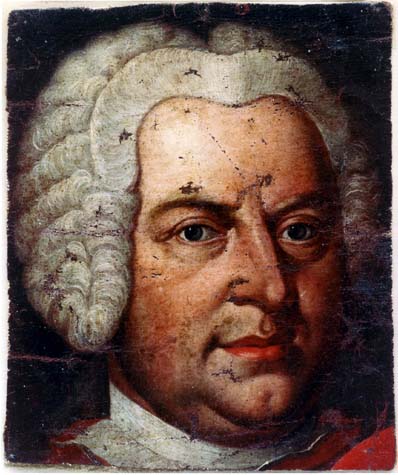
presents the Weydenhammer fragment
as a
second authentic portrait. DW]
The distinction between the "public" Bach and the "private" Bach, the
distinction between Bach as a professional musician and Bach as a
musical intellectual, is of crucial importance, not only to the
understanding of the Bach iconography as a whole but also to the raison
d'être for the lost Kittel portrait, and therefore to the
Weydenhammer Portrait Fragment, in particular. And the effects of this
distinction should not be discounted or overlooked.
There can be no doubt in anyone's mind that the persona we
see in the Haussmann portraits is the persona that Bach sought to
immortalize visually in the only portrait image that, so far, he is
known to have commissioned, and even then perhaps with some reluctance
and trepidation. The Haussmann image is Sebastian Bach as he wanted
himself to be seen by posterity, and, when one considers the multitude
of images that have been derived from this basic image over the course
of the past 250 years, it is clear that in that goal he succeeded beyond
his wildest expectations. It is everywhere, and its omnipresence
subliminally tints our attitudes towards "competing" personae
with a power that borders on the draconian. The Haussmann Bach is on
coffee mugs. It is on sweatshirts. It is on bar towels and tote bags. It
is on the sides of buildings. There are psychedelic versions and surreal
ones. It is on chiming clocks and foulards. It has even been the model
for a porcelain coffee pot.
The Haussmann portrait of Bach is the equivalent of the Athenaeum
Portrait of George Washington.