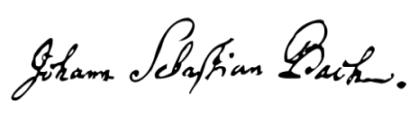
Easter-oratory of J.S. Bach (BWV 249)
and the Shepherds-cantata
Some curious aspects of the music become
self-evident when you realize that the original texting was not the
religious one (1 April 1725, Easter-sunday), but a secular cantata
gratulating performed for the Duke of Sachsen-Weissenfels at his
birthday (23 February 1725), a serenade using the traditional imagery
and dramatis personae of the 'Pastorale': shepherds
(male/female), sheep, and flowers. The aria's and choruses are retexted
by Picander (?), the music probably remained the same. One exception
perhaps: the way the last line of n° 9 is expanded (before the Da
Capo). The aria which certainly wins a lot by using the original
text is the aria for Soprano and Traverso (both in atmosphere and
wordpainting: 'schmeicheleien', 'wallen'). The famous Schweisstuch-aria
now is a straigtforward lullaby, sung by the shepherd,
intended for his sheep... to sleep softly till the morning comes. Odd
word-accents often turn out to be quite natural phrasing when one looks
to the original text. Personally I am most delighted with the last two
lines of the Shepherd's cantata: The triumphant fugue "So werden sich
künftig bei stetem Gedeihen / Die Deinen mit Lachen und Scherzen
erfreuen." is the final congratulation: "Mazzel tov!", "Happy Birthday",
"Lang zullen ze leven" (in Dutch)...
Listen to this 'jubilation' (final chorus, nr. 10 Glück und Heil...
)
|
original text (gratulationcantata /
Shepherdscantata) |
text of the first version of the Eastercantata |
|
2. |
3. |
|
4. |
5. |
|
6. |
7. |
|
8. |
9. |
|
10. |
11. |
Dick Wursten (dick@wursten.be)